
iWild Casino Payment Methods: Cards, E-Wallets, Crypto and AUD Context
 Available in AU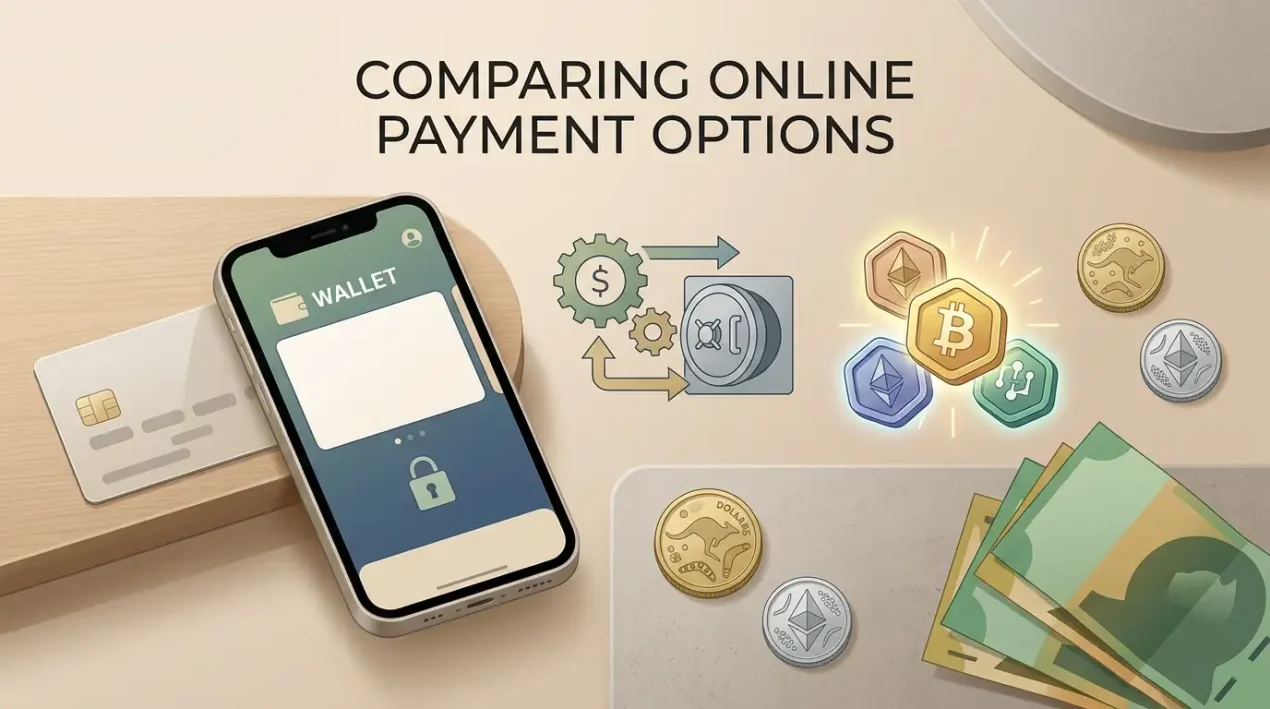
Contents
Cashier and banking
iWild supports a broad mix of payment categories: Visa and Mastercard, e-wallets such as Skrill, Neteller and MiFinity, bank transfer, and cryptocurrencies including Bitcoin, Ethereum, Litecoin and USDT. AUD is also listed or observed as an iWild account or cashier currency. Those platform capabilities are useful for comparing the cashier, but they do not prove that an Australian resident can currently register, deposit or use every listed method.
For Australian readers, the practical comparison is between iWild’s global cashier and familiar local payment habits. Cards remain Australia’s dominant consumer payment method, mobile-wallet use is widespread, and PayID is mainstream. Current iWild payment information does not confirm PayID support, so PayID is not included in the cashier list. Crypto is treated as a payment capability, not as a route around account, country or regulatory restrictions.
Which iWild payment methods are verified?
The most stable way to describe the cashier is by category rather than by promising that one exact list will appear for every account. Current independent sources agree that iWild supports cards, e-wallets, bank transfer and cryptocurrencies. Current payment-method evidence specifically includes Visa and Mastercard; Skrill, Neteller and MiFinity; bank transfer; and crypto options such as Bitcoin, Ethereum, Litecoin and USDT.
That breadth is useful because it gives several funding models inside one platform. A card is familiar and direct. An e-wallet creates a separate payment layer between a bank account and the casino. A bank transfer uses account-to-account banking rails. Crypto uses a blockchain asset and wallet. These methods differ in setup, settlement and availability, so the cashier should be checked at the account level before any transaction.
| Category | Verified examples | What this page does not assume |
|---|---|---|
| Cards | Visa, Mastercard | That every card type works for every region or for both deposits and withdrawals. |
| E-wallets | Skrill, Neteller, MiFinity | That the same wallet selection appears for every currency or account. |
| Banking | Bank transfer | That iWild supports every Australian account-to-account service. |
| Cryptocurrency | Bitcoin, Ethereum, Litecoin, USDT and other crypto options | That crypto changes country eligibility or regulatory requirements. |
| Currency | AUD is listed or observed as an account or cashier denomination | That AUD support proves Australian resident acceptance. |
AUD support is a currency fact, not an access decision
AUD support matters because it can reduce the need to think in a foreign display currency when the cashier presents an Australian-dollar account or denomination. Current iWild payment information lists or shows AUD as an account or cashier currency. That is a narrower statement than saying the casino accepts Australian residents.
Currency menus and account eligibility answer different questions. A platform can support a currency for operational, marketing or regional reasons without that currency proving the legal or contractual status of every user who holds it. The same applies in reverse: an account may use a non-local currency even when a reader is located in a country where that currency is not standard.
For that reason, this guide keeps the payment page focused on what the cashier can do. The broader iWild Australia review explains why Australian account acceptance remains a separate verification question, while the iWild licence and trust page handles operator and licensing checks.
Cards still match the way Australians usually pay
The Reserve Bank of Australia’s 2025 Consumer Payments Survey found that cards remained the most widely used consumer payment method in Australia, with debit cards accounting for roughly half of consumer payments. That makes card support a familiar part of iWild’s cashier when compared with ordinary Australian payment behaviour.
The comparison should not be stretched too far. Paying a supermarket or utility bill with a debit card is not the same product or regulatory context as depositing to an online casino. The useful point is simply that Australian consumers are highly accustomed to card-based payments, so Visa and Mastercard are immediately recognisable cashier categories.
Card availability can also be directional. A method visible for deposits is not automatically guaranteed for cashouts, and an issuer can apply its own controls. That is why the iWild withdrawals page treats payout routing as a separate process instead of assuming that every deposit rail works identically in reverse.
Mobile wallets are common in Australia, but that does not create iWild wallet support
The RBA survey also shows how strongly mobile payments have become part of everyday Australian behaviour. In the 2025 survey, 43% of consumers used a mobile device for a contactless payment during the diary week. That makes phone-based payment habits familiar even when the underlying funding source remains a card or bank account.
iWild’s verified cashier list includes e-wallet services such as Skrill, Neteller and MiFinity. Those are different from assuming support for every mobile wallet an Australian might use. A phone can be the device used to access a cashier, but the available payment rail is still whatever method the account actually displays.
This distinction is especially relevant on smaller screens. The iWild mobile guide covers browser access and the mobile experience, while this page stays with the funding categories rather than treating mobile use as a separate payment method.
PayID is mainstream in Australia, but iWild PayID support is not verified
PayID is one of the clearest examples of why local payment familiarity and casino support must be separated. The RBA’s 2025 survey found that around half of respondents had used PayID at least once in the previous year. It is therefore a mainstream Australian account-to-account tool and an obvious method for local readers to look for.
Current iWild payment information does not confirm PayID support. Current iWild payment-method evidence instead centres on cards, international e-wallets, bank transfer and crypto. This page therefore leaves PayID out of the supported-method list rather than inferring it from the fact that bank transfer is available.
Crypto is a verified iWild capability, not a bypass route
iWild supports cryptocurrency payments and crypto-denominated play options. Current payment information includes major assets such as Bitcoin, Ethereum, Litecoin and USDT, with independent payment lists showing a broader crypto selection around those core names.
For a payment comparison, crypto changes the mechanics rather than the underlying eligibility question. A crypto transfer uses a wallet address and blockchain network rather than a card or traditional bank rail. Network choice, wallet compatibility and transaction finality therefore matter in ways that do not apply to a debit-card payment.
What crypto does not do is turn an uncertain country-access position into a verified one. It should not be treated as a method for evading location controls, terms or legal restrictions. Readers comparing crypto with fiat methods should judge it on payment handling, familiarity and the exact cashier options displayed to the account.
Deposits and withdrawals should be evaluated as two different stages
A long deposit-method list can make a cashier look flexible, but the withdrawal side may be narrower. Some payment methods are better suited to funding than receiving payouts, and casinos can require a return to an original or compatible method. Verification can also become relevant at cashout even when depositing was simple.
This is why exact withdrawal limits, processing windows and method-specific settlement times are not folded into the general payment table above. They change more quickly, carry higher factual risk and answer a different user question. The dedicated cashout guide explains the verified 3x deposited-funds turnover rule, KYC checkpoint and the difference between casino review time and payment-provider settlement time.
Bonus rules are another separate layer. A deposit can be technically successful without automatically qualifying for a promotion, and current iWild welcome-offer terms have varied across sources. The iWild bonuses page keeps those promotional conditions away from the basic question of whether a payment category exists.
How to compare the iWild cashier without over-reading the method list
Four practical checks
- Confirm which methods are actually visible for the account currency and region rather than relying on a global list.
- Check whether the intended method supports deposits, withdrawals or both.
- Keep AUD display support separate from Australian resident eligibility.
- Do not assume PayID support unless it is explicitly shown in the current cashier; do not substitute generic bank transfer evidence.
These checks matter more than counting logos. A cashier with many methods can still be inconvenient if the preferred payout route is missing, while a shorter list can work well when the methods match the reader’s normal financial setup. The decision should be based on the method actually available for the intended transaction.
Australia’s broader shift toward digital transactions also matters here. The RBA found that online payments made up about one-fifth of consumer payments in its 2025 survey. That does not make an online casino payment locally authorised, but it does explain why Australians are used to completing payment journeys through browsers, apps and stored digital credentials rather than only at a physical terminal.
How iWild’s cashier options compare with Australian payment habits
iWild’s verified cashier covers several payment categories Australians already understand: cards, digital wallets, bank transfer and crypto, with AUD appearing as a supported account or cashier currency, and the fit is strongest at the broad category level. Cards align with Australia’s card-heavy payment habits, and e-wallet access suits a market where mobile payment use is widespread.
The most important mismatch is informational rather than technical. PayID is widely used in Australia, but iWild PayID support is not verified, so it should not be assumed. Likewise, AUD support does not settle whether an Australian resident can currently open or fund an account. The useful reading is therefore narrow: iWild has a broad international cashier with AUD and crypto capability, but the exact methods shown to an account and the separate question of Australian eligibility still need to be checked on their own terms.
This material was created by the iWild Australia Guide team.
Related posts
iWild Casino in Australia: Access, ACMA Rules and Regulatory Context
iWild Withdrawals: Process, Limits, Verification and Timing Checks